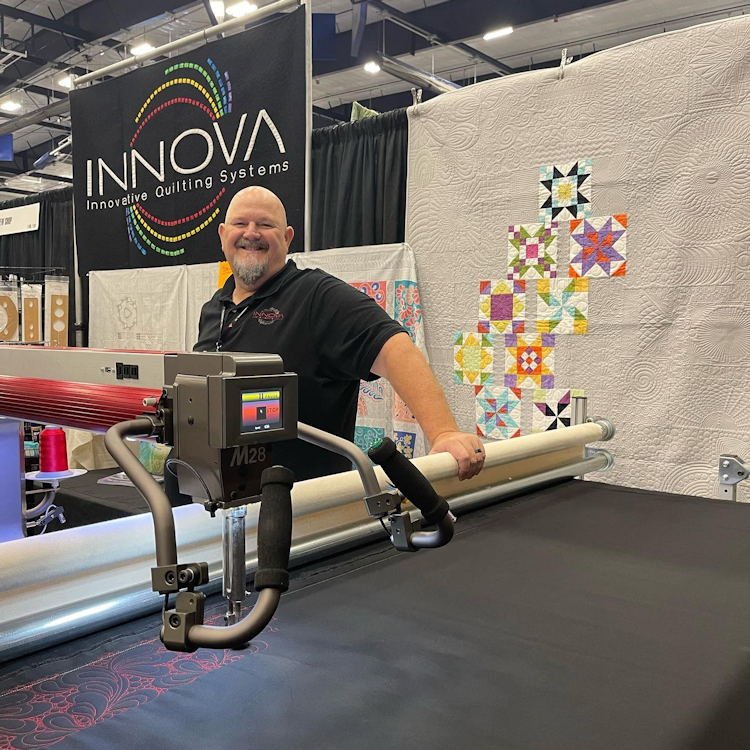
Jim started his quilting career back in 2010 when his wife pulled him from being a professional bass fisherman to help her run the Sew So Shop.
Jim and Nicky knew immediately that long arms were going to be a key factor that kept the quilt store singing. 16 years later and thousands of quilts under his belt, Jim is still stitching along. Over the 16 years, he has developed a keen understanding of the important and not-so-important features that are key when making a longarm decision.
Level: All Levels Class Type: Lecture/Demo Category: Other Machine(s): Not required
Here are the things to consider when you begin looking.
Which Machine? There are a lot of different manufacturers out there, so you owe it to yourself to research and try them all. (Innova, APQS, Gammill, A1, Handi Quilter, Tin Lizzie, and Nolting to list just a few)
Yahoo Groups. Almost every long arm brand has a group for owners to talk and compare notes. Check the different sites, and ask how satisfied customers truly are. This is a great source for real input.
Used Machines. Why are some brands highly available, and others not? A few good sources to check are Long Arm University, Craigslist, and eBay.
How does it drive? Is it smooth, and does it feel light? Is it easy to operate? Does it catch or grab when running?
Stitch Quality. Does it have a stitch regulator? Are all the stitches uniform in length and quality? Is a digital stitch regulator available, and what is it?
Horsepower. How strong is the motor? The stronger the motor, the less drag you will feel when driving and the fewer problems you will have sewing through multiple layers of fabric, as well as tougher fabrics.
The Frame. Some suppliers will tell you pieced poles are good, but in actuality, a solid pole is better because a pieced pole will give you a joint, which is a weak point. The integrity of the spacing between the poles is crucial for creating a good quilt. The stronger the poles, the better.
Set up and Delivery. How do you get the machine? Who delivers it? Who puts it together? Is it set up for you, or do you have to do that yourself?
Training. Is training included with the purchase? If not, how much does training cost? If included, where do you go for training? How much training do you get?
Support. You have a problem; what do you do now? Is there phone support? Is there local support? Who comes to work on the machine if you do need something?
Warranty. How long? What is covered?
Upgradability. If you want to add something later, can you? Can you add automation after the fact?
Size. The larger the throat, the less you have to roll the quilt to complete it. If you are considering automation, you might want a larger throat.
Where is it made? There are actually only a few machines that are made in the US. Is that important to you?

 Jim started his quilting career back in 2010 when his wife pulled him from being a professional bass fisherman to help her run the Sew So Shop.